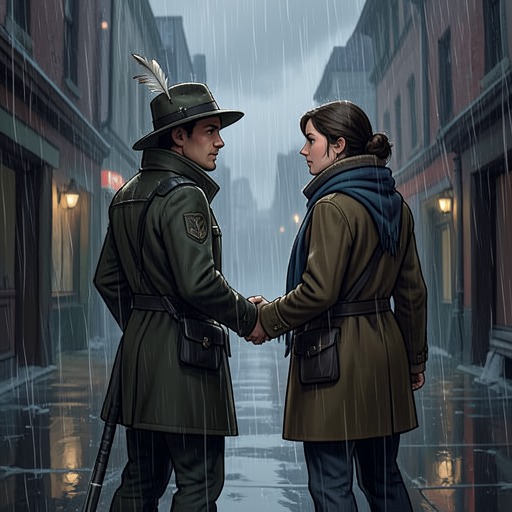
Dorrigo Evans and Amy pass each other on the Sydney Harbour Bridge
The Narrow Road to the Deep NorthThe encounter between Dorrigo Evans and Amy Mulvaney on the Sydney Harbour Bridge is a reunion that never becomes a meeting: Dorrigo sees the woman he thought dead, but hesitation carries them past each other without a word. Their brief crossing turns the distance of more than a quarter-century into an immediate choice, then makes that choice irreversible. For Dorrigo, the sight of Amy restores a love he believed lost; his failure to call out leaves him confronting the possibility that the life he has been living is itself a kind of death.
The Walk and the First Sight
Dorrigo Evans sets out on foot after leaving the hospital, where Tom has just told him something that he needs to come to terms with. The city is sweltering and crowded with American servicemen on leave from the Vietnam War. Following the walking advice he gives his patients, Dorrigo goes from the hospital to Circular Quay, then continues across the Sydney Harbour Bridge, intending to visit a surgeon friend in Kirribilli. The walk begins as an attempt to escape the crowds and heat; it becomes the route to an encounter he has never expected to have again.
In the middle of the bridge, a light easterly brings a cooling sea breeze. Below, white and blue waves break against the water; ochre-red cranes surround the unfinished opera house, whose exposed framework recalls the veins of dry gum leaves to Dorrigo. The late sun divides the city into bands of light and shadow. This sharply observed setting also shapes the encounter: as Dorrigo resumes walking, he sees a woman momentarily emerge from darkness into light, then lose sight of her among the people crossing the bridge. He glimpses her again beneath the sandstone pylon at its northern end, framed by the arch and partly obscured by the moving crowd.
Recognition and the Life Between
On his third glimpse, the woman is close enough for Dorrigo to see her clearly. She wears fashionable sunglasses and a sleeveless dark-blue dress with a white band at the hips. Two small girls hold her hands; they laugh and chatter, and she replies, though the bridge’s reverberating traffic noise prevents Dorrigo from hearing them. The children’s presence establishes, in the few seconds available to him, that the stranger belongs to a life he does not know. He recognizes features in the girls that he takes to be unmistakably their mother’s, alongside something that is not hers and hurts him.
The woman is Amy Mulvaney. Dorrigo had thought her dead. More than a quarter-century has passed since he first saw her through shafts of dusty light in an Adelaide bookshop, but the changes time has made do not diminish his feelings. He notices her bleached hair, her slightly gaunt face, and the self-possession he reads in it; age seems to him to have revealed rather than taken something from her. The recognition is not a calm recollection: feelings he thought gone return with the force of their first intimacy, while the sight of Amy’s children makes the intervening years tangible.
The Unmade Approach
As Amy comes nearer, Dorrigo weighs whether to stop, cry out, or say nothing. He imagines both the lives they have had apart and the possibility that they could begin again. At the same time, he tells himself that he must not intrude on her life or cause chaos; the competing impulses leave him physically unsteady, with a churning stomach and an uneven balance. Close enough to see the small mole above her lip, he no longer thinks in terms of her beauty. What he knows is that he wants her.
A necklace sparks an uncontrollable rush of memory. Dorrigo wonders whether Amy has seen him and resolves to call out. Then he sees her pinch her dress between thumb and forefinger and tug it back up at the cleavage. In the full sunlight behind her, he briefly expects that she might welcome him into her arms and her life. The moment’s radiance offers no assurance, however; it intensifies the gap between his imagined reunion and what either of them has actually done. Amy keeps walking towards him, and he approaches her, but the scene turns on the words he is about to say and does not say.
Passing, Recognition, and Loss
They walk past each other without speaking. Dorrigo keeps to the shadow and looks straight ahead. He understands that he has misjudged Amy, himself, their shared past, love, and time, but this recognition comes too late to guide him back. The scale of the error overwhelms him: although he could turn, call out, or run after her, he cannot make himself do so. Only when he reaches the far end of the bridge does he find the strength to turn around. Amy is nowhere to be seen.
Dorrigo stands amid the stream of pedestrians, reduced in his own perception to an obstruction among the traffic of the city. He thinks of Lot’s wife and rejects the story’s lesson: in his understanding, it is by failing to turn and look back that a person becomes a pillar of salt. He knows he should have stopped Amy, and that now he never can; he also knows that he should not have walked on, yet did. The questions that follow—whether either of them chose, or whether life simply swept them together and apart—remain unresolved. The crowd continues in every direction around the ironwork, stone, sea, cranes, and expressway, while Dorrigo experiences the world as emptied by the loss of the person he loves. He turns again and keeps walking. He had believed Amy dead; at last, he understands the reversal as one in which she has lived and he has died.